● THE GROWTH ENGINE
The growth engine for home services
HACKTICS runs your paid ads and installs the tracking layer underneath them — so every dollar of spend traces to the job it produced. We run the campaigns, hold the thread from first click to signed job, and show cost per job by campaign.
● For home services companies spending $3K+/month on paid ads
THE PROBLEM
WHY THE THREAD BREAKS
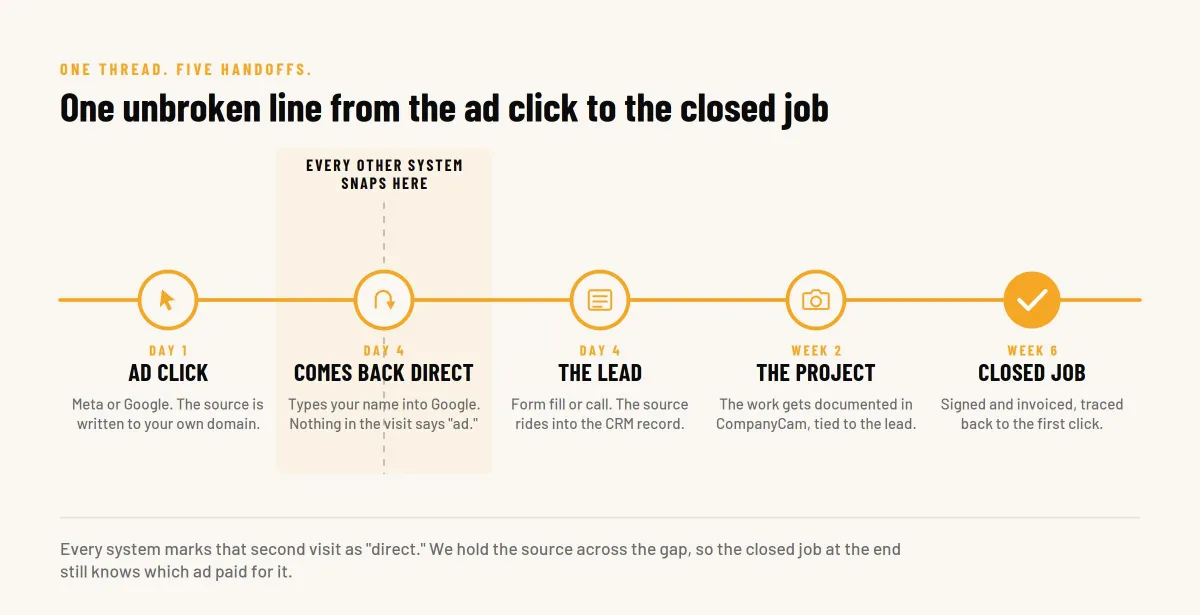
Home services jobs are expensive, considered, and slow. A roof, a system replacement, a full siding job - nobody buys one in a single sitting. The homeowner clicks, leaves, thinks about it, talks to a spouse, and comes back days later.
01
The gap loses the plot
The homeowner returns by typing your company name into Google. There's no ad attached to that visit — your analytics files it under "direct."
02
The ad gets killed
The ad that started the whole thing shows zero conversions. At the end of the month it gets switched off for underperforming.
03
The job forgets its origin
Then the job gets sold and lands in your production CRM. Nothing in that record knows it began with an ad you just killed.
That's not a marketing problem. It's a tracking problem - and everything below is how we fix it.
THE FIX
HOW THE THREAD STAYS CONNECTED
Four things have to hold, in order. Break any one and the chain snaps - which is why partial setups produce confident, wrong numbers instead of no numbers.
01
Capture the source on the first visit
Every ad carries UTM parameters, and the moment a visitor lands we write that source to first-party storage on your own domain. Not held in the session. Not inferred from a referrer header that may not survive the trip.
02
Hold it across return visits
This is the step almost every setup skips, and it's the one that matters. When the homeowner comes back three days later by typing your name into Google, our tool, TraceLever, recognizes the same visitor and keeps the original ad source attached to them.
BREAKS WITHOUT IT
The return visit gets credited as "direct," and the ad that created the demand looks like it did nothing.
03
Carry the source into the lead
When the form is submitted or the call comes in, the original ad source rides along into your CRM. Most home services companies run a marketing CRM like GoHighLevel on the front end and a production CRM like AccuLynx for the actual work.
BREAKS WITHOUT IT
The ad source dies in the handoff between the two systems, and by the time the job exists, nothing remembers where it came from.
04
Match the lead to the Project > Job
The lead becomes a project in CompanyCam and eventually a closed job in AccuLynx. Both trace back to the same original click. This is the step that turns cost per lead into cost per job — the only number that tells you whether the spend was worth it.
SEE WHERE YOUR THREAD BREAKS
GET YOUR FREE TRACKING REVIEW
Roofing and Home Service companies spending $1.5K+/month. 30 minutes. No stress. Free Audit.
ON TOP OF IT
WHAT WE RUN
ON TOP OF IT
Tracking on its own is a dashboard. The engine is tracking plus the campaigns that feed it.
We run full-funnel paid media across Meta and Google - Google Search for the homeowners already looking, Meta for the ones who don't know your name yet. We handle the creative and copy, turning your jobsite footage into ads. Storm response, free inspection, financing: we know what converts because we've run it before.
Because the tracking is underneath all of it, campaign decisions get made on job data, not lead data - the difference between optimizing toward cheap form fills and optimizing toward signed work.
Cost per job, by campaign
Integrations
What it connects to
Ad Platform
Meta Ads
Spend and creative performance by campaign, ad set, and ad.
Ad Platform
Google Ads
Spend and search performance by campaign and keyword.
Marketing CRM
GoHighLevel
The lead record, with the ad source attached at capture.
Field Ops
CompanyCam
The project - proof the lead became real work.
Production CRM
AccuLynx
The closed job and its invoiced value.
Run something else - Jobber, Leap, ServiceTitan, JobNimbus? Tell us on the review call. The chain is the same shape regardless of which CRM sits at the end of it. No doubt your CRM is already on our Roadmap.
YOUR PART
WHAT WE NEED FROM YOU
Less than you'd think, and none of it falls on your crews.
A. Access to your ad accounts and pages
We work inside your accounts, not ours - you own them, and you keep them if we ever part ways.
B. A kickoff conversation
Your ideal customer, your margins, the jobs you actually want more of. We can do most of this in a 1-hour onboarding call.
C. Jobsite footage and photos
You're already taking them. Send them over and we turn them into ads - nothing outperforms real work on real roofs.
D. Your ad budget, paid directly to the platforms
Never through us. You see exactly what Meta and Google charged, with no markup in between.
STRAIGHT ANSWERS
WHERE IT STOPS
You should hear where our tool ends from us, not find out in month three.
• WHAT WE TRACE TODAY
The chain from the ad click to the project created in CompanyCam and in your production CRM. That's real, it's live, and it's what cost per job is calculated from.
• ON THE ROADMAP
We do not yet trace collected cash — money actually in your bank. When it ships we'll say so. Until then, "produced work" means signed and invoiced, not banked. Anyone who blurs those two words is telling you something they can't back up.
We'd rather hand you a smaller number you can trust than a bigger one you can't.
Who It's For
Who this is built for
Home services companies spending at least $1,500 a month on paid ads, with enough job volume for the data to say something. Roofing is where we started and where most of our work is. It works the same way for HVAC, siding, and anyone documenting jobs in CompanyCam and closing them in a production CRM.
The trades change. The broken thread doesn't.
FAQ
Frequently asked questions
What is the HACKTICS Growth Engine?
It's three things working together: full-funnel paid ads across Meta and Google, a first-party tracking layer that holds the ad source from the first click through to the signed job, and reporting that shows cost per job by campaign. The tracking is what makes the ad spend accountable.
How is this different from Google Analytics or the Meta pixel?
Google Analytics and the Meta pixel both stop at the website. They can tell you a form was submitted; they cannot tell you the job was signed six weeks later for $22,000. The engine connects the ad click to the job record in your production CRM, which is where the money actually shows up.
Do I have to change my CRM or how my crews work?
No. We connect to what you already run - GoHighLevel, CompanyCam, AccuLynx, Meta, Google. Nothing gets replaced and nothing changes in the field. The tracking layer sits underneath the tools you already use.
Does HACKTICS track revenue I've actually collected?
Not today (yet). We trace to the closed and invoiced job value in your production CRM, which is signed work, not banked cash. Connecting payment data is on the roadmap. We label it "closed" or "invoiced" rather than "collected" because those are different numbers and the difference matters.
How long before the tracking shows anything useful?
Tracking goes live in the first week, but the signal builds over time. Home services jobs take weeks to go from first click to signed contract, so the first full picture of cost per job arrives once enough of those journeys have completed. Persistence over time is the point, not day-one numbers.
See where your thread breaks
Get Your Free Tracking Review